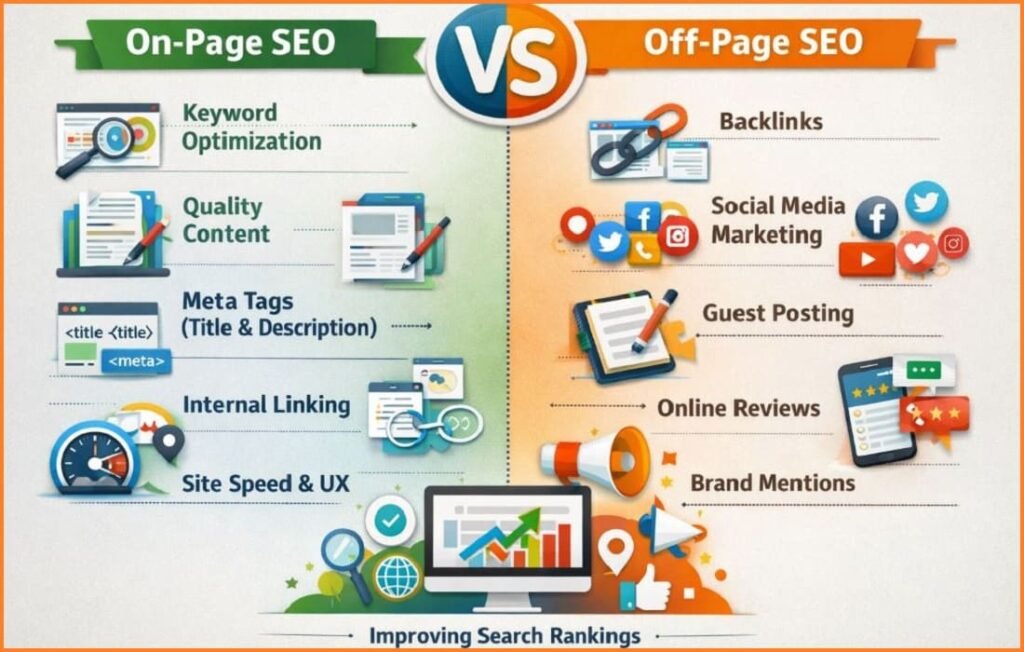
On-page SEO is the foundation of every successful website. No matter how strong your backlinks are or how powerful your domain looks, poor on-page optimization can block your rankings.
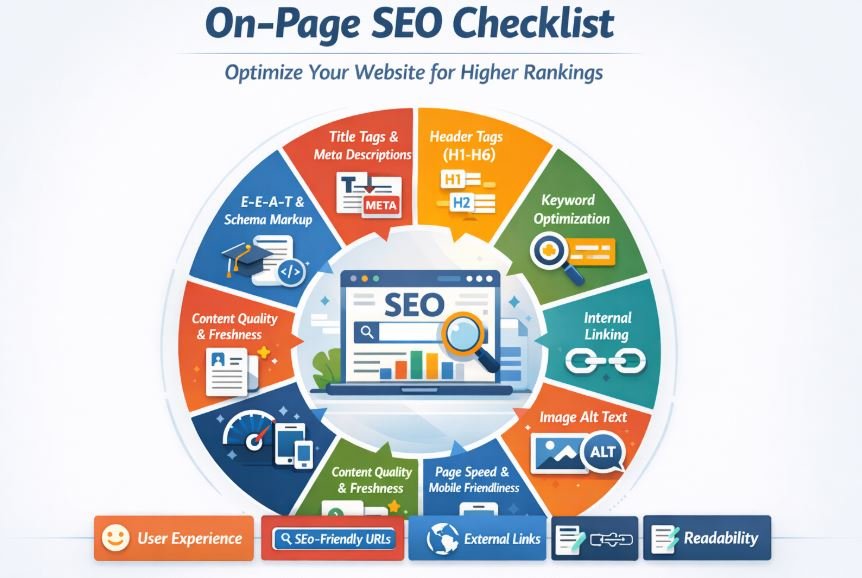
This On-Page SEO Checklist for 2026 is designed to help you optimize every critical element on your page—from titles and content to UX and technical signals—so search engines and users both love your site.
On-Page SEO Checklist in 2026
Let’s break it down step by step.
1. Title Tag Optimization
The title tag is one of the strongest on-page ranking factors. It’s the first thing users see in search results and plays a major role in click-through rate.
Best Practices:
-
Keep length between 50–60 characters
-
Place the primary keyword near the beginning
-
Write for clicks, not just rankings
-
Add branding when relevant
Example:
-
✅ On-Page SEO Checklist 2026: Boost Rankings Faster
-
❌ On Page SEO, SEO Tips, SEO Guide, SEO Optimization
2. Meta Description Optimization
While meta descriptions don’t directly affect rankings, they strongly influence CTR, which impacts overall SEO performance.
Best Practices:
-
Ideal length: 150–160 characters
-
Include primary and secondary keywords naturally
-
Focus on benefits, not just features
-
Add a clear CTA
Example:
Discover the complete on-page SEO checklist for 2026, including titles, content, internal links, and schema to improve rankings.
3. Header Tags (H1–H6 Structure)
Header tags help search engines understand your content structure and improve user readability.
Proper Hierarchy:
-
H1: Main topic (only one per page)
-
H2: Main sections
-
H3–H6: Subsections
SEO Benefits:
-
Better content scanning
-
Higher chance of featured snippets
-
Improved accessibility
4. Keyword Placement & Optimization
Keyword placement signals relevance to search engines. The goal is natural integration, not repetition.
Where to Use Keywords:
-
Title tag
-
Meta description
-
H1 and subheadings
-
First 100 words
-
Image alt text
-
URL
-
Body content (naturally)
Important Rules:
-
Avoid keyword stuffing
-
Use semantic and LSI keywords
-
Write for humans first, algorithms second
5. Image Alt Text Optimization
Alt text improves image SEO and accessibility for screen readers.
Best Practices:
-
Describe the image clearly
-
Add keywords naturally
-
Keep under 125 characters
-
Avoid stuffing
Example:
alt="On-page SEO checklist for website optimization"
6. Internal Linking Structure
Internal links guide users and search engines across your site.
SEO Benefits:
-
Distributes link equity
-
Improves crawl depth
-
Reduces bounce rate
-
Strengthens topical authority
Best Practices:
-
Use descriptive anchor text
-
Link only to relevant pages
-
Avoid excessive linking
-
Use pillar–cluster content models
7. Schema Markup Integration
Schema markup helps search engines understand your content better and enhances SERP appearance.
Common Schema Types:
-
Article
-
FAQ
-
Product
-
Review
-
Breadcrumb
-
Organization
Benefits:
-
Rich results
-
Higher CTR
-
Increased SERP visibility
8. URL Optimization
SEO-friendly URLs improve rankings and user trust.
Best Practices:
-
Keep URLs short and readable
-
Include target keywords
-
Use hyphens, not underscores
-
Avoid unnecessary parameters
Example:
-
✅
/on-page-seo-checklist -
❌
/page?id=123seo
9. Content Quality & Depth
Content is still king—but helpful content wins in 2026.
Key Factors:
-
100% original and plagiarism-free
-
In-depth and comprehensive
-
Matches search intent
-
Structured for easy reading
-
Updated regularly
Google prioritizes people-first, experience-based content.
10. Page Loading Speed
Page speed affects rankings, UX, and conversions.
Optimization Tips:
-
Compress images
-
Enable browser caching
-
Minify CSS and JavaScript
-
Use a CDN
-
Optimize Core Web Vitals
11. Mobile Friendliness
With mobile-first indexing, your site must perform flawlessly on mobile devices.
Requirements:
-
Responsive design
-
Readable text without zooming
-
Tap-friendly buttons
-
Fast mobile load time
12. User Experience (UX) Signals
Google measures how users interact with your page.
Key UX Metrics:
-
Bounce rate
-
Dwell time
-
Scroll depth
-
Page layout clarity
Better UX = Stronger rankings
13. Content Freshness
Updated content consistently outperforms outdated pages.
Best Practices:
-
Refresh stats and data
-
Update keywords
-
Improve formatting
-
Add new insights or sections
14. External Linking (Outbound Links)
Linking to trusted sources improves credibility.
Tips:
-
Link to relevant, authoritative websites
-
Use natural anchor text
-
Avoid spammy or low-quality domains
15. Readability & Formatting
Readable content keeps users engaged longer.
Formatting Tips:
-
Short paragraphs
-
Bullet points
-
Tables where necessary
-
Clear headings
-
Simple, conversational language
16. E-E-A-T Optimization (2026 Focus)
Google emphasizes Experience, Expertise, Authoritativeness, and Trustworthiness more than ever.
How to Improve E-E-A-T:
-
Author bio with credentials
-
Cite credible sources
-
Show real-world experience
-
Secure HTTPS website
-
Transparent contact information
How On-Page SEO Works in 2026?
SEO in 2026 focuses on:
-
Search intent over keywords
-
User satisfaction signals
-
AI-driven understanding
-
Content depth and authenticity
-
Experience-based optimization
On-page SEO is no longer about tricks—it’s about value.
Final Thoughts
On-page SEO is not a one-time task—it’s an ongoing optimization process. A properly implemented On-Page SEO Checklist helps you:
-
Rank higher in search engines
-
Increase organic traffic
-
Improve user experience
-
Boost engagement and conversions
If you master on-page SEO, everything else in digital marketing becomes easier.